Bruno Elan Track Customization: Options for Your Stairs
When investing in a stair lift, one size rarely fits all. The Bruno Elan stands out because its track system can be tailored to the specific geometry of your staircase—whether it’s straight, curved, or has intermediate landings. Understanding these customization options helps you choose a configuration that maximizes safety, comfort, and long-term reliability.
How Does the Bruno Elan Track Fit Different Staircase Shapes?
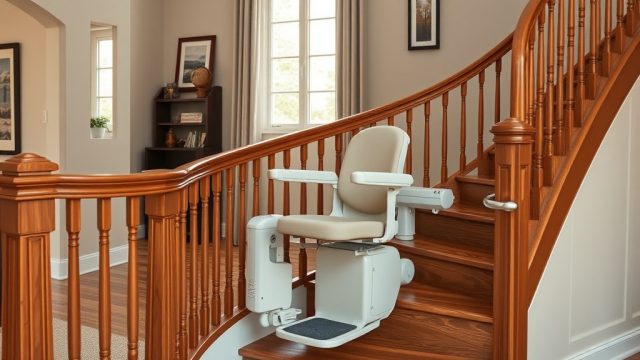
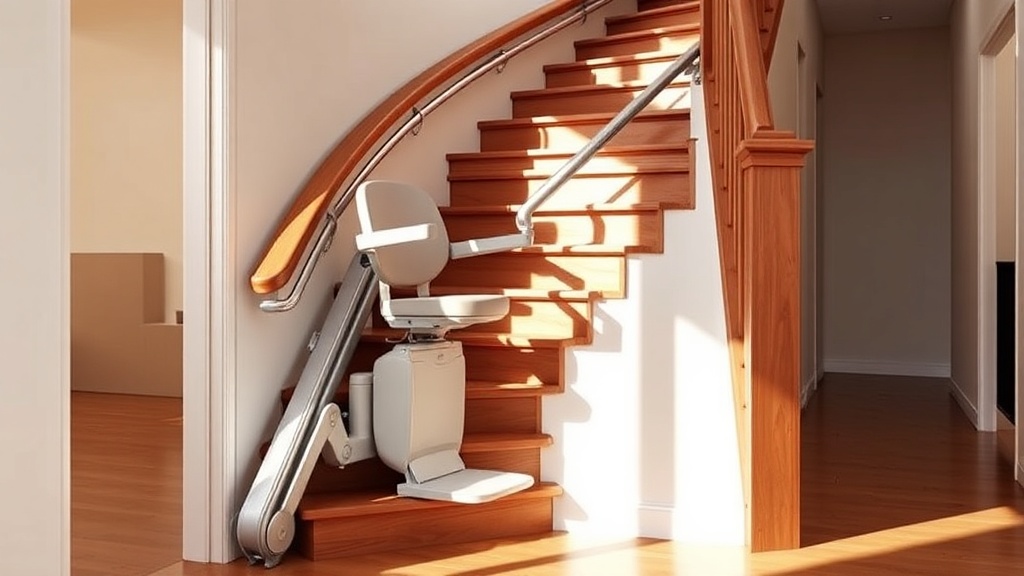
The Bruno Elan uses a modular rail system that accommodates straight, curved, and spiral staircases. For straight runs, the track is a single extruded aluminum section that mounts directly to the treads or stringers. Curved stairs require a custom-bent rail, which Bruno fabricates based on a precise template of your staircase—typically within 2–3 mm accuracy. The rail sections are joined with flush-mount connectors that maintain a smooth transition for the carriage, preventing jerky movements. For landings, the track can include a continuous curve or a break with a powered hinge section, allowing the chair to fold and navigate 90-degree corners without manual lifting.
Installers take measurements of the stair width, rise, and any obstructions like newel posts or radiators. The rail is then produced with integrated power and data cables inside the extrusion, ensuring no external wiring. This custom fit eliminates gaps that could cause the chair to wobble, and it allows the seat to stay parallel to the handrail even on tight bends.
What Rail Extensions Are Available for Landings and Top of Stairs?
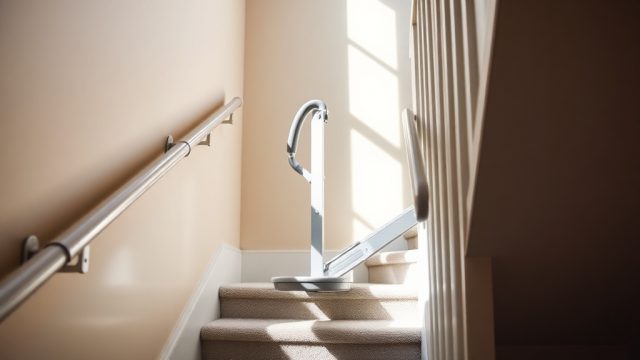
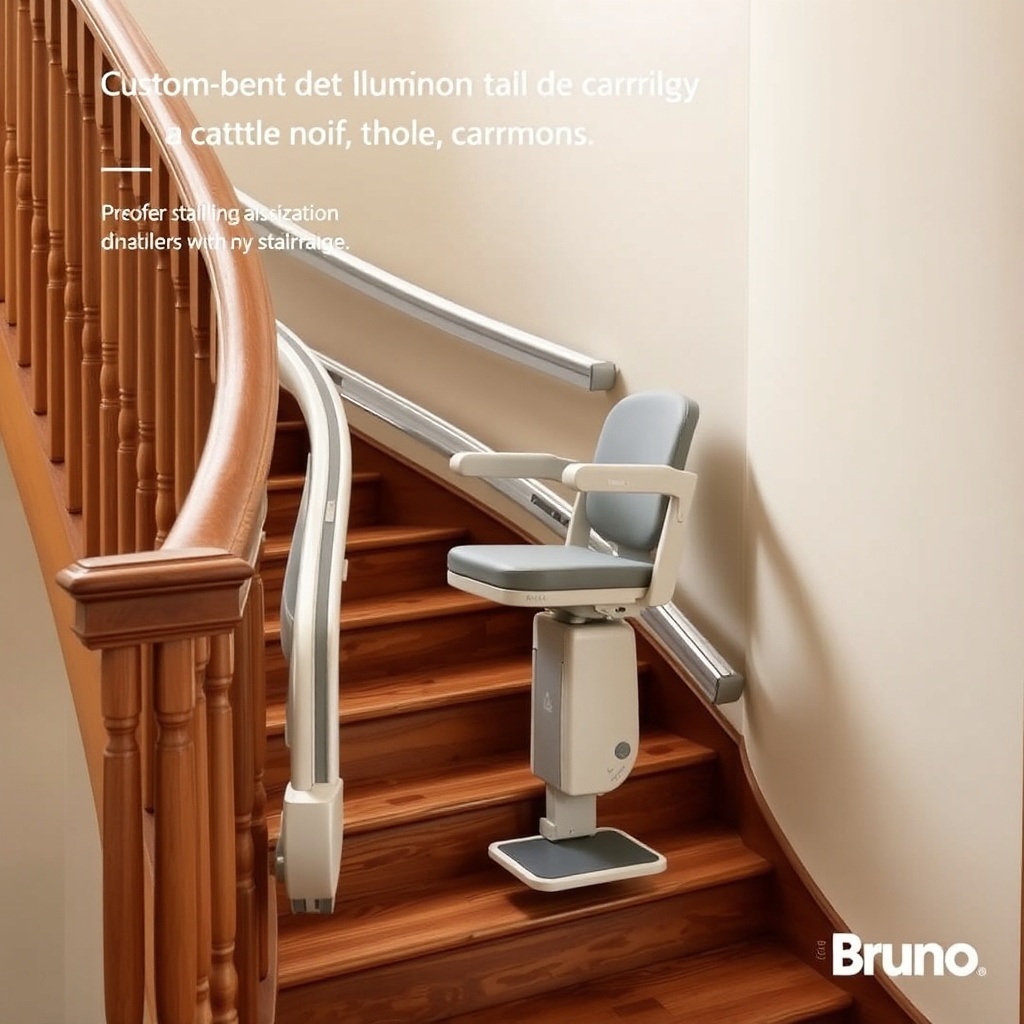
The Bruno Elan offers standard and extended rail lengths at both ends of the stairway. A typical straight stair installation uses a rail that extends about 12 inches past the top step and 6 inches past the bottom step. For wider landings—for example, a top landing that is 4 feet wide—you can add a metered extension up to 36 inches. This allows the chair to park out of the walkway, preserving traffic flow. The extension is a continuous piece of the same rail profile, with a locking stop at the end to prevent over-travel. On curved installations, the landing rail section is custom-bent to tuck against the wall or follow a floor contour, often requiring a template drawn on site.
A practical consideration: if your landing has a door that opens inward, a longer extension ensures the chair clears the door swing. Bruno recommends at least 18 inches of clearance between the chair’s folded position and the door arc. The extension kits are sold separately and typically cost between £200 and £400 depending on length and curvature complexity.
Can the Bruno Elan Track Be Installed on Outdoor Stairs or in Tight Spaces?
Yes, the Bruno Elan has an outdoor-rated track option for covered exterior stairs—such as porch steps or garage entrances. The outdoor rail uses a marine-grade anodized finish and stainless steel mounting brackets to resist corrosion. The motor and carriage are sealed to IP54 standards, protecting against rain splashes and dust. For tight interior spaces—like narrow winding stairs with less than 600 mm of tread width—Bruno offers a slim profile rail that is 80 mm wide (versus the standard 90 mm). This reduction shaves off just enough width to clear door frames or tight landings without sacrificing structural rigidity. The slim rail uses the same carriage but slightly narrower wheels, and it supports the same 125 kg weight capacity.
Before deciding on a slim rail, measure the clear floor space at the top landing: you need at least 450 mm of flat surface to park the chair in its upright folded position. If the landing is smaller, consider a hinged rail section that folds upward when not in use, though this is a less common customization.
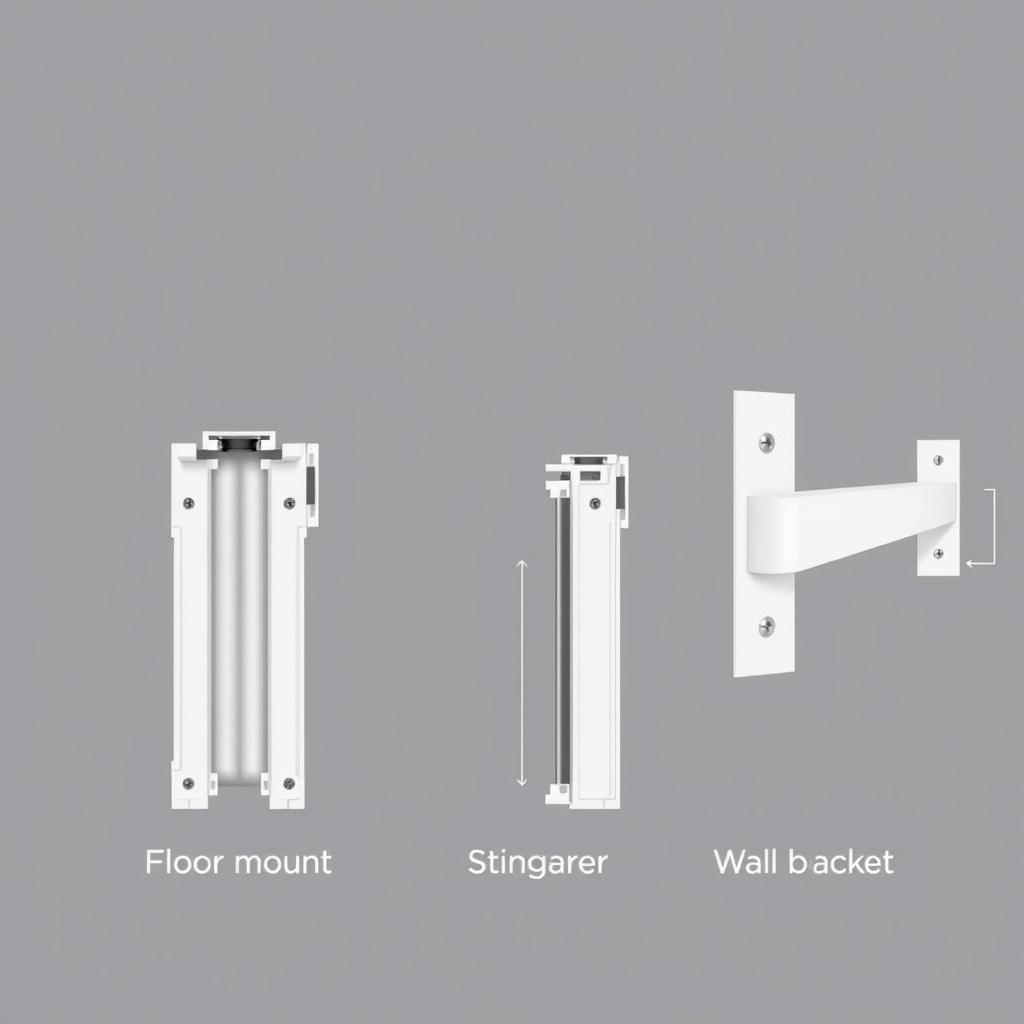
How Do Track Mounting Options (Floor vs. Stringer vs. Wall) Affect Stability?
The Bruno Elan track can be mounted in three primary ways, each suited to different stair constructions:
- Floor mounting: Brackets bolt directly into the concrete or wood treads. This is the strongest method, preferred for heavy use (multiple trips per day). It distributes load across the joists and minimizes vibration. Typical for homes with solid wood or concrete stairs.
- Stringer mounting: Brackets attach to the side stringer (the vertical support board at the edge of the stairs). This avoids drilling into the tread surface, which is useful for finished hardwood stairs where you want to preserve the look. Stringer mounting requires the stringer to be at least 38 mm thick and no more than 30 mm from the tread edge.
- Wall mounting: Brackets secure to the adjacent wall if the stairs are open on one side. This is common for spiral staircases or where the treads are too thin for floor anchors. Wall mounting uses a separate rail support bracket every 600 mm, and the wall must be solid (brick, concrete block, or reinforced studwork) to handle dynamic loads. Drywall without backing is not suitable.
All three mounting types use the same track extrusion and carriage, so you can switch methods later if needed, though it requires drilling new holes in the rail. For curved tracks, stringer mounting is rare because the bend often twists away from the stringer; floor mounting is the default.
What Track Angle and Slope Adjustments Are Possible for Very Steep Stairs?
The Bruno Elan is designed for stair angles between 25 and 65 degrees from horizontal. Most domestic stairs fall between 30 and 45 degrees. For stairs steeper than 45 degrees (common in older homes or cottage lofts), Bruno offers a “steep slope” rail profile that lowers the carriage’s center of gravity by 15 mm and increases the track’s toothed belt tension. This prevents the chair from tilting forward during ascent. The adjustment is made via a calibrated slider on the carriage’s base plate, which the installer sets using a digital inclinometer. The steep slope option also adds a secondary braking system that engages at angles above 50 degrees, providing redundant safety.
For stairs below 25 degrees (very shallow ramps), a standard track works fine but the chair’s speed may feel slow. Bruno offers a firmware option for “low-angle speed boost” that increases the travel speed from 0.1 m/s to 0.15 m/s on shallow slopes, reducing ride time for long straight runs. This requires a service technician to update the control board via a USB connection.
How Do Rail Materials and Finishes Compare for Durability and Aesthetics?
The Bruno Elan track is manufactured from 6063-T5 aluminum alloy, chosen for its corrosion resistance and strength-to-weight ratio. The standard finish is a clear anodized satin that matches most home décor and resists scratching from shoe scuffs. For homes with high humidity (e.g., coastal areas or homes with unheated stairwells), you can opt for a powder-coated finish in white, bronze, or black. The powder coat is baked at 200°C, creating a thick layer that withstands salt spray tests of 1,000 hours per ASTM B117. The stainless steel mounting brackets are electropolished, which makes them less likely to pit in wet environments.
Aesthetic considerations: the anodized finish reflects light more, which can make the rail noticeable against dark stairs. The powder-coated bronze or black blends better with walnut or painted staircases. Bruno also offers a “woodgrain” vinyl wrap for the rail (an additional £150 upcharge), which mimics oak or mahogany. This wrap is applied post-installation and can be replaced if damaged, but it is not recommended for outdoor use because prolonged UV exposure causes delamination.
Customization Comparison: Standard vs. Premium Track Options
| Option | Standard (Included) | Premium (Extra Cost) |
|---|---|---|
| Rail length (straight stairs) | Top extension 12 in / bottom 6 in | Up to 36 in at top, 18 in at bottom |
| Rail width | 90 mm | 80 mm (slim profile) |
| Finish | Clear anodized satin | Powder coat (white/bronze/black) or woodgrain wrap |
| Outdoor rating | Not included | Marine-grade anodized + IP54 seals |
| Mounting method | Floor mounting | Stringer or wall mounting adapters |
| Steep slope adjustment | Up to 45° standard slope | Up to 65° with secondary brake |
What Owners Say
Margaret from Edinburgh had her Bruno Elan installed on a curved Edwardian staircase with a tight 90-degree turn. She noted, “The rail fits perfectly into the corner with the folded seat flush against the wall—our hallway is only 700 mm wide, and we still have room to pass with shopping bags.” Owners frequently mention that the custom-bent rail on curved stairs reduces wobble compared to previous straight-rail adaptations they’d seen in other homes. Another owner, Tom from Kent, uses the outdoor-rated track on his covered back steps. He said, “After two winters, the anodized rail hasn’t shown a spot of rust, and the carriage runs smoothly even when grit gets tracked in.” Some report that the slim profile rail on narrow stairs saves just enough space to keep the landing usable for a small table, though they recommend measuring twice because the folded seat still protrudes 50 mm.
Frequently Asked Questions
1. Can the Bruno Elan track be reused if I move to a new home?
Yes, the track can be unbolted and reinstalled in another home with a similar staircase geometry. The custom-bent sections for curved stairs are specific to the original shape and cannot be reshaped, but straight rail sections and standard brackets can be reused. Bruno recommends having a certified installer handle removal and reinstallation to avoid damaging the rail or carriage.
2. How long does it take to install a custom curved track versus a straight one?
A straight track installation typically takes 2–3 hours. A curved track requires a site survey for custom bending, followed by a 2–3 week fabrication period, then 4–6 hours of installation on-site. The extra time accounts for adjusting the landing extensions and making sure the carriage follows the entire bend smoothly.
3. Is the track adjustable if my staircase settles or shifts over time?
The mounting brackets have slotted holes that allow up to 10 mm of vertical adjustment per bracket. If the house settles, an installer can loosen the bolts, align the rail level again, and retighten. This is only possible if the brackets are bolted to solid treads or stringers; wall-mounted tracks have no vertical adjustment built in.
4. What weight does the track support, and does customizing affect that limit?
The Bruno Elan track is rated for 125 kg (275 lbs) regardless of customization. The slim profile and steep slope options use the same extrusion cross-section and carriage bearings, so the weight capacity remains unchanged. Outdoor and indoor tracks share the same structural rating.
5. Do I need to reinforce my stairs before installing a custom track?
Most homes do not need reinforcement. The track mounts with at least four brackets per 3-meter section, each distributing load across multiple treads or a single stringer. For very steep stairs (above 55 degrees), Bruno recommends an additional bracket every 600 mm to reduce flex. A pre-installation inspection by a structural engineer is only required if the stairs are visibly deteriorated or made of softwood like spruce.
6. How do I clean and maintain the track after customization?
Use a dry microfiber cloth to wipe the rail surface monthly, removing dust and pet hair that can clog the belt drive. For the powder-coated finish, a damp cloth with mild soap is fine. Avoid silicone-based lubricants on the rail itself—they attract dirt. Every 12 months, a technician should inspect the bracket bolts for torque loss and the belt tension, which may need a 0.5 mm adjustment after the first year of settling.
For more details on the installation process, see our Bruno Elan Stair Lift Installation: Step-by-Step Guide. To understand how track angle affects battery travel distance, read the Bruno Elan Battery Life: Real-World Usage Test. For costs associated with custom track options, check Bruno Elan Pricing and Warranty: What’s Included.